
An open infrastructure for comparability of public spending
WikiControl develops an infrastructure technological that integrates, normalises and analyses public data on municipal management. The platform combines different sources of information to enable comparative efficiency analyses.
Three layers of information
1. Budgetary data
Budgetary data constitute the fundamental basis for understanding how public administrations allocate and use economic resources. Through official budget settlements, it is possible to know in detail which areas public money is invested in.security, education, social services, infrastructure or general administration.

However, although this information is in the public domain, Its structure and level of detail do not always allow for direct analysis. The data is usually organised according to technical classifications that make them difficult to interpret for non-specialist users, and moreover, they present differences in their application between administrations.

WikiControl tackles this challenge by collecting, standardising and structuring this data, allowing complex accounting information to be converted into understandable and comparable indicators. This process is essential for being able to to analyse the efficiency of public spending and establish a solid foundation upon which to build any rigorous evaluation.

Without proper budgetary data interpretation, it is impossible understand how resources are allocated or identify potential areas for improvement in public administration.


2nd Public Procurement Data
Procurement represents a very significant part of public spending. y it is one of the key areas for analysing how that spending is executed in practice. Through public contracts materialise many of the services that citizens receive.

The tender and award data allow us to understand fundamental aspects such as:

- The amount of the contracts
- Suppliers awardees
- The procedures used
- The frequency and allocation of contracts

Nevertheless, these data is scattered across different platforms, with heterogeneous formats and with classifications that do not always accurately reflect the actual service provided. This makes their systematic analysis and comparison between administrations extremely difficult.

Wikicontrol integrates and standardises this information. to be able to analyse it in a structured way. This allows, for example, Compare prices of similar services between municipalities, identify award patterns or detect relevant deviations from usual values.

Public procurement analysis it does not aim to make judgments, but rather to provide structured transparency that facilitates better understanding on how public spending is executed and how it can be optimised.
3. Results data and contextual indicators
The analysis of public spending cannot be limited solely to how much is spent. To evaluate the efficiency of an administration, it is essential to understand what results are obtained from that expenditure and in what context it occurs.

For this reason, WikiControl incorporates a third layer of information based on outcome indicators and contextual variables. These include, but are not limited to:

Sector indicators (crime rates, educational attainment, etc.)
– Demographic variables (actual population, density, trends)
Economic and territorial factors

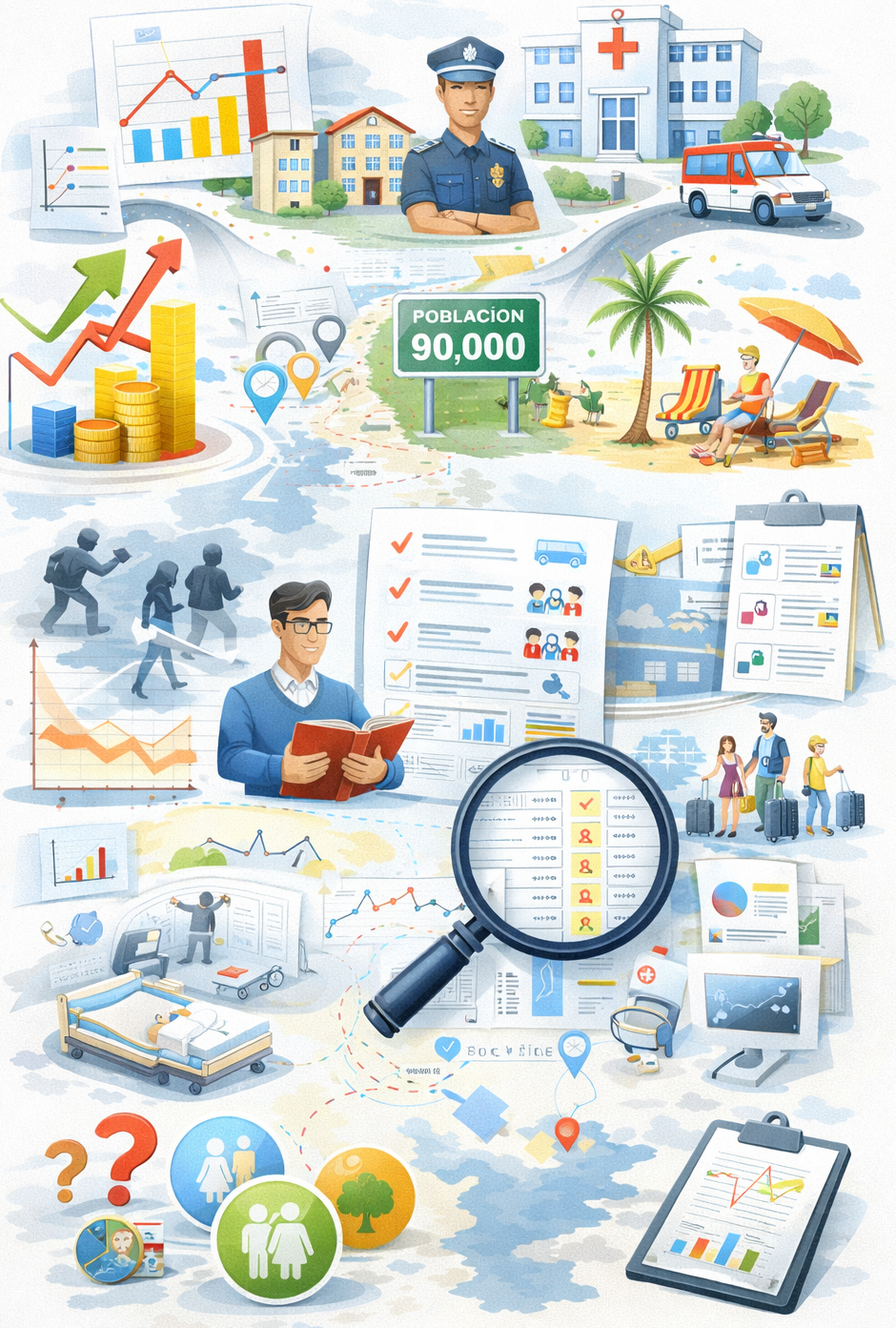
These data allow for a correct interpretation of public spending. For example, two municipalities may have similar spending on security, but operate in completely different contexts in terms of population, economic activity, or tourist pressure.

Without this contextual layer, comparisons can be incomplete or even erroneous. Incorporating these indicators allows for a move from descriptive analysis to explanatory analysis, where relationships between resources used and results obtained can be identified.

Adjusted comparisons
One of the main problems in the analysis of public spending is the use of simplified comparisons that they do not take into account the real differences between territories.

Compare per capita expenditure between municipalities without considering factors such as floating population, tourism, economic activity, or urban structure can lead to wrong conclusions. Municipalities with very different characteristics require different levels of spending to provide equivalent services.

WikiControl develops adjusted comparison models that incorporate these contextual variables., allowing for more precise and realistic analyses. This involves, for example, calculating indicators based on equivalent population rather than census population, or adjusting ratios according to specific territorial characteristics.

The objective is not to establish simplistic rankings, but to offer tools that allow for an understanding of differences and facilitate a rigorous analysis of public spending efficiency.

This approach significantly improves the quality of the analysis and avoids misinterpretations that can distort public debate.
Use of artificial intelligence
Artificial intelligence plays a key role in Wikicontrol's capabilities to process large volumes of information and transform unstructured data into useful knowledge.

A relevant portion of public information is found in poorly accessible formats, such as PDF documents, annual reports, or technical reports. Using automatic language processing techniques, it is possible to extract relevant data from these documents and structure it for analysis.

Furthermore, Artificial intelligence allows:

- Detecting anomalies statistics on budgetary and procurement data
- Identify patterns behaviour over time
Improve contract classification when official categories are insufficient
- Facilitate access to information through natural language queries

Es importante destacar que Wikicontrol no utiliza la inteligencia artificial para emitir conclusiones automáticas ni juicios de valor. Su función es identificar patrones y señalar datos que merecen análisis adicional.

La combinación de capacidades tecnológicas avanzadas con un enfoque metodológico riguroso permite a Wikicontrol ampliar significativamente el alcance y la utilidad del análisis de datos públicos.
